FINANCING
FEAR
Some corporations pursue profits no matter the costs. Unfortunately, those costs are often devastating. This is why we went after HSBC for laundering the drug money that funded cartel terrorism.
Lesley Redelfs was shot twice in the head.
The sicarios, Mexican cartel assassins, surrounded her SUV at an intersection in Ciudad Juarez, Mexico. It was broad daylight, a Saturday. Lesley and her husband, Arthur, were on their way home from a child’s birthday party when the bullets crashed through the passenger side window.
Arthur sped away, making a frantic run for the border he would never reach. The cartel enforcers caught up, and Arthur Redelfs was struck by at least nine bullets, including one that severed his spinal cord. The SUV drifted and crashed at the entrance to the Stanton Street bridge.
The Redelfs’ infant daughter was found screaming in the back seat.
LIVING IN A STATE OF TERROR
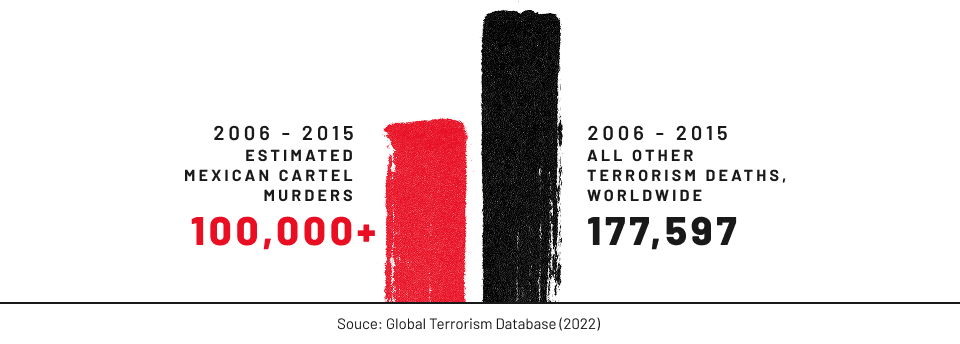
This tragedy is not isolated. It’s anything but. Between 2006 and 2015, Mexican drug cartels are estimated to be responsible for more than 100,000 murders.
No one is safe.
From 2006 - 2010, the U.S. State Department reported at least 994 people under the age of 18 were killed by cartels. Children were actually targeted with the express purpose of terrorizing the population.
More than 100 journalists since 2000 have lost their lives to the cartels. That doesn’t count social media bloggers who were met with equal levels of violence.
Among the estimated 174 public officials assassinated between 2006 and 2012, 83 of them were police chiefs.
The murders were almost always public, brutal and preceded by torture. Bodies were hung from overpasses, disemboweled, mutilated. Cartel atrocities were broadcast on social media. Decapitated heads were posted for all to see, with notes warning others, called “narcomantas.”
For every murder, there were 10 times as many kidnappings. In 2012 alone, the U.S. State Department counted 105,682 cartel abductions.
The violence was (and still is) intended to instill fear and control the population, law enforcement and government.
The cartels are, by definition, terrorists. In early 2025, 10 years after this case, they were officially designated as Foreign Terrorist Organizations by the U.S. government.
From 2006 to 2010
Since 2000
Between 2006 and 2012
FOLLOW THE MONEY
Fear isn’t the only cartel currency. Mexican drug lords also need to move vast amounts of actual currency.
Narcotics and human trafficking, among other illicit enterprises, net huge sums of cash revenues. The cash, however, is unwieldy. It’s vulnerable to seizure and easy to find in an investigation.
In order to disguise the source, and trail, of illegal funds — and to finance their operations, corrupt local authorities, purchase equipment and weapons, buy drugs and hire paramilitary-style mercenaries — cartel assets need to be integrated into the global financial network. Everything they do hinges on converting illicit proceeds into what appears to be legitimate account balances.
In other words, money laundering is the lifeblood of a cartel.
For years, global banks looked the other way. At times, they even helped cartel operatives launder billions of blood-stained dollars through their branches.
We were the first to file such a claim.
PAYING THE PRICE FOR SOMEONE ELSE’S GREED
Elias Law brought the complaint on behalf of the surviving family of Lesley and Arthur Redelfs, as well as victims of two other deadly cartel attacks. The injured and slain were all U.S. citizens. Three of them, including Lesley Redelfs, worked for the U.S. government.
Special Agents Jaime Zapata and Victor Avila Jr. were ambushed on a peaceful mission, delivering equipment to Mexico City. Their armored vehicle was forced off the road. During the ensuing struggle, Los Zetos hit men managed to get the barrel of an AK-47 through a small crack in the window. Agent Zapata died on the way to the hospital. Agent Avila survived, but his life was permanently and irreparably altered.
Raphael Morales, Jr. was abducted by the Sinaloa cartel on his wedding day. At least 16 assassins, all bearing assault rifles, waited in the church courtyard. Raphael, his brother Jaime Morales and their uncle Guadalupe Morales were all kidnapped. Tortured. And killed by asphyxiation. The Sinaloan enforcers, and their boss, knew the three men were innocent. They wrapped the victims heads in duct tape anyway.
The banks profited while these families lost everything.
Our case was the first of its kind, the first to label the criminal bank behavior for what it is: support of terrorism. By aiding the cartels’ money laundering efforts, we argued that HSBC effectively provided material support of the cartels’ ability to operate, including — and, tragically, not limited to — the heinous attacks on our plaintiffs and their families.
MAKING HEADLINES
Naturally, the case garnered media attention. A free press was also a victim of cartel violence. News outlets all over the world picked up the story, shining a light on the bank’s role in financing fear — as well as the merits of the plaintiffs’ novel claim.


ETHICALLY BANKRUPT
The ways in which HSBC failed their obligations to identify and restrict illegal activity in their bank branches were pervasive and ongoing.
HSBC intentionally implemented criminally deficient anti-money laundering (AML) programs, guaranteeing that cartel banking activities avoided suspicion
Employees routinely processed illicit proceeds that showed unmistakable signs of money laundering — such as customers depositing vast sums with no known source of income
Some employees regularly fabricated documents indicating they had performed required customer due diligence when they had not
Even when accounts were flagged and ordered to be closed, employees failed to report the activity to authorities and left the accounts open for years
Senior bank executives and leaders were aware of the AML failings and did nothing to stop, or even slow, the deposits of illegal funds
In multiple instances, bank employees accepted bribes from cartel money launderers to help orchestrate massive money laundering schemes
None of these activities caught HSBC by surprise. They went on for a decade leading up to the attacks on our clients, and there were ample warnings.
Annual warnings from the US State Department tabbed Mexico with the highest rating for potential money laundering, urging banks to take “special care” to guard against such threats
The US Treasury Department issued its own warnings to similar effect
The US State Department also issued regular warnings of cartel terrorist activities
Yet, inexplicably, the US division of HSBC assigned Mexico the lowest threat level in their automated internal monitoring systems. Based on this designation, more than $670 billion was able to flow from HSBC Mexico to HSBC US without any AML scrutiny or controls.
In early 2008, the CEO of HSBC Mexico was warned that as much as 60% - 70% of all laundered cartel proceeds in the country went through his bank. According to one drug lord, HSBC was “the place to launder money.” Nothing changed. By the end of 2008, the bank tallied a record year of illicit bulk cash deposits.
A senior level HSBC employee characterized the bank’s culture as one of “pursuing profit and targets at all costs.”

The burden of proof, and that of guilt
In a separate case brought by the U.S. Department of Justice, HSBC entered into an agreement with the United States, admitting all of the failures above.
In our case, we had to prove the bank provided support to the cartels knowing, or intending, that the money would be used to commit a violent crime.
Given the cartels’ gruesome history, how could any reasonable person NOT have known? How could they assume their complicity was doing anything other than helping to finance the deadliest terrorist organizations in the world?
No part of the bank’s actions were legitimate, and they can’t be made to appear so. As it turns out, it’s not as easy to launder guilt.